



Gov. Paul LePage is pointing to his record on mental health care spending as he lobbies the Obama administration and Maine’s congressional delegation to follow his lead rather than support increased gun control in response to the shootings in Newtown, Conn.
But the governor’s record is mixed when it comes to supporting programs that serve people with mental and behavioral health problems, say advocates who monitor Maine’s mental health care programs.
Additional Photos
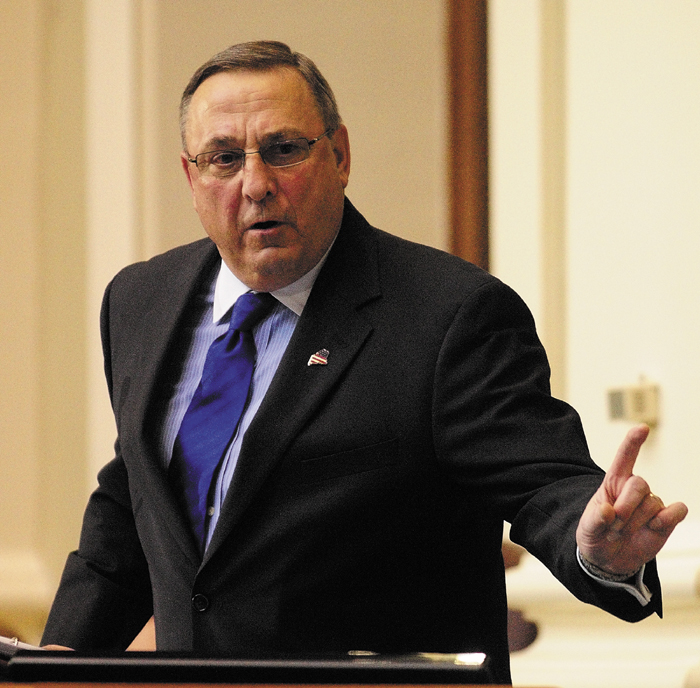
LePage released letters Wednesday that he sent to Vice President Joe Biden on Jan. 16 and to Maine’s congressional delegation on Feb. 1, each saying that “the problem we face has little to do with firearm ownership and nearly everything to do with mental health issues.”
LePage noted that he has increased funding for mental health services required under a consent decree by $2 million, and that he has increased funding for people with developmental disabilities by $6.7 million.
While mental illnesses differ from developmental disabilities, LePage wrote that he is “confident these initiatives will mean much more to the individuals receiving these services – and will provide more public safety – than simply enacting unnecessary gun laws.”
LePage noted in an accompanying news release that Maine recently got a notable B grade from the National Alliance on Mental Illness and that the state increased its mental health budget 15 percent from 2009 to 2012.
LePage also noted that he worked with mental health advocates to open a clubhouse in Lewiston that provides support and employment for about 160 people who have mental illness.
Indeed, LePage has increased funding under the consent decree, which applies to the Riverview Psychiatric Center in Augusta and community mental health programs statewide, said Helen Bailey, general counsel for the Disability Rights Center of Maine, the agency that sought the consent decree.
LePage added $2 million for mental health programs called for under the consent decree in the supplemental budget he proposed for the fiscal year ending June 30 and the first year of the next biennial budget.
“You can’t take that away from him – he did ask for that,” Bailey said.
However, LePage also issued an order in December to reduce spending on mental health services by $1.8 million, Bailey said.
The Legislature retained the $2 million increase in the supplemental budget that won approval Thursday afternoon, and it restored nearly $1 million of a $1.2 million cut that the LePage administration had proposed in mental health crisis services.
“We’ve seen the governor cut health care and crisis services for the mentally ill in multiple budget proposals since his term in office,” said House Speaker Mark Eves, D-North Berwick. “If we are going to work together to prevent tragedies like Newtown, we must have a comprehensive approach that looks at mental illness, gun violence, and safety protocols.”
The LePage administration has $6.7 million in its proposed budget for the two years starting July 1 to help 85 of 176 mentally disabled Mainers who are on a waiting list for group-home placement and other services.
However, LePage plans to fund the effort by cutting other programs that serve the same group of people, advocates said.
His proposed supplemental budget cut the group-home program by more than $3.2 million for the fiscal year that ends June 30, and he plans to cut $24 million from related programs in 2013-14 and 2014-15, advocates said.
Maine was one of only six states to get a B grade in the National Alliance on Mental Illness’ 2009 report card on mental health care in the United States. No state got an A.
Maine won points for having one of the lowest uninsured rates in the nation and because its Dirigo health plan provides equal coverage for mental illness and substance abuse disorders. Dirigo is being phased out in anticipation of the federal Affordable Care Act taking its place next year.
Maine’s actual spending on mental health care dropped from $201 million in fiscal 2007-08 to $174 million in fiscal 2011-12, according to the Department of Health and Human Services. The department also experienced mental health care budget curtailments totaling $12.4 million during that period.
“The network of best-practice, community-based, integrated treatment care that allows people to live successfully in our communities has eroded over the past decade,” said Cathy Kidman, interim executive director of NAMI Maine. “This is where funding is most needed.”
Kidman warned against equating mental illness with violence, noting that one in four American adults experiences a mental health disorder in a given year.
“The focus of gun control efforts should be on steps to keep highly lethal weapons out of the hands of dangerous individuals, whether or not they have a mental illness,” Kidman said.
Kelley Bouchard can be contacted at 791-6328 or at:
kbouchard@pressherald.com
Send questions/comments to the editors.

Success. Please wait for the page to reload. If the page does not reload within 5 seconds, please refresh the page.
Enter your email and password to access comments.
Hi, to comment on stories you must . This profile is in addition to your subscription and website login.
Already have a commenting profile? .
Invalid username/password.
Please check your email to confirm and complete your registration.
Only subscribers are eligible to post comments. Please subscribe or login first for digital access. Here’s why.
Use the form below to reset your password. When you've submitted your account email, we will send an email with a reset code.