



AUGUSTA — One-time fixes, including almost completely raiding the state’s reserve fund, represent almost all of the LePage administration’s proposed plan to close a $112 million current-year budget gap in the Maine Department of Health and Human Services.
“We’re halfway through the fiscal year and we have the pressure to spend $112 million,” said Sawin Millett, commissioner of administration and finance, after a Friday press briefing. “You just can’t achieve savings this far into a fiscal year, so you have to come up with these kinds of one-time solutions.”
Additional Photos
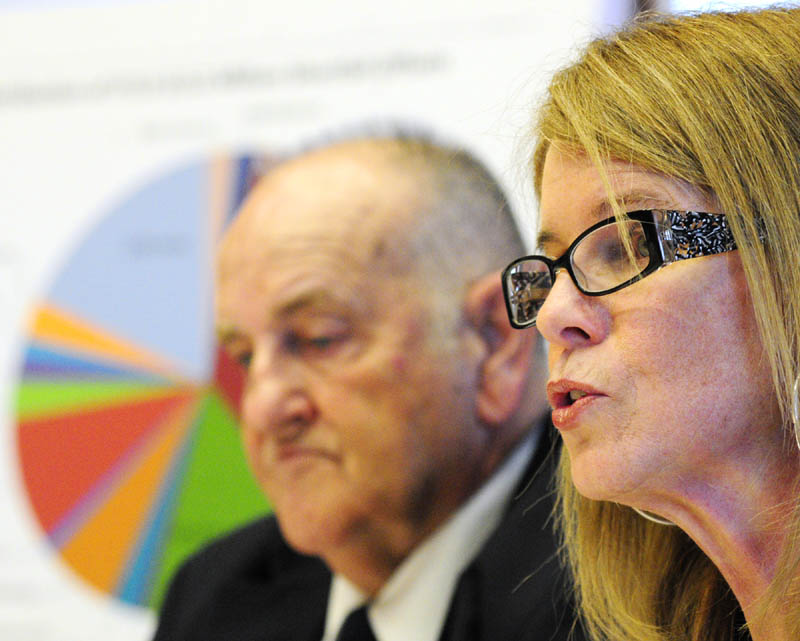
The proposal looks mostly uncontroversial: state Sen. Dawn Hill, D-York, chair of the Maine Legislature’s appropriations committee, which will mull the proposal, said her first feeling was relief that most of the savings didn’t come at the expense of programs, though there were small cuts.
“I think this will build a lot of positive work for the committee and I think we’ll come to a consensus on this relatively quickly,” Hill said.
The administration said the DHHS shortfall for the budget year ending in June was driven mainly by the need for $87 million in supplemental funding in MaineCare, Maine’s Medicaid program. That included $54 million in over-budget expenses, along with not being able to implement certain Medicaid changes the last Republican-led Legislature approved, but the federal government rejected.
Millett said the largest single component of the proposal to solve the gap will leverage $40 million of $44.5 million in state’s Budget Stabilization Fund, or the rainy day fund.
“That’s why you have the stabilization fund,” said Rep. Kathleen Chase, R-Wells, the ranking Republican on the Legislature’s Appropriations Committee. “When we move forward, we’ll be putting back money into the stabilization fund.”
Millett said $18.5 million will come from a two-week deferral of General Purpose Aid to Maine schools, pushing it into the next budget year, where it would be paid as part of the next biennial budget. He said $17.1 million will come by raiding “rarely used” state working capital funds. Revenue from the Oxford casino was also leveraged, Millett said.
There was some proposed additional spending for 2013, the administration said. It included $4.2 million to address an increase of children in Maine’s foster care system and $2 million in mental health funding for some not eligible for MaineCare.
The proposal did contain small program eliminations, payment reductions and adjustments — totaling less than $4 million of the total package for 2013. Apart from that, general assistance to municipalities was also proposed to be capped at just above $10 million, which the administration wants to continue in LePage’s proposed budget for the 2014-15 fiscal years, also released Friday.
The biggest proposed cut in the 2013 proposal — elimination of the totally state-funded Drugs for the Elderly Program — will save $1.75 million. But elimination of the program also continues into LePage’s proposal for the 2014 and 2015 fiscal years, saving $14 million over that period.
Hill said Democrats on the appropriations committee could look to restore that program as budget negotiations ensue.
“I just don’t feel that’s a place we can go,” she said. “These elderly people, they don’t have options for more income. They don’t have the option to go out and get jobs.”
There would also be a $1.2 million reduction for hospital outpatient services, a 10 percent cut. More than $600,000 would be cut by reducing reimbursement rates to rural critical access hospitals, which the administration would also like to continue into the next biennial budget.
Other than that, hospitals were mostly absent from both the DHHS and biennial proposals released by LePage’s administration — notable since the governor campaigned on paying down hospital debt and has prioritized doing so during his administration.
Maine hospitals are owed $484 million in overdue Medicaid reimbursements. Maine’s share of the debt, some of which dates back to 2009, is $186 million. The state must pay that share to unlock federal dollars that would pay for the full amount.
But at Friday’s budget briefing, Millett said LePage is working on paying down hospital debt in full, leveraging money from a liquor contract set to be re-negotiated this year. He said the governor wants to borrow money to pay hospitals, but then use liquor revenue to quickly amortize that borrowed money.
Senate Majority Leader Seth Goodall, D-Richmond, said it’s too soon to commit to or evaluate specifics of the proposal, but both parties are committed to pay back debt.
“We are committed to working toward paying down the hospital debt,” he said. “We look forward to learning more from Sawin Millett and the governor on their thoughts on re-negotiating the liquor contract.”
State House Bureau writer Steve Mistler contributed to this report.
Michael Shepherd — 370-7652
mshepherd@mainetoday.com
Send questions/comments to the editors.

Success. Please wait for the page to reload. If the page does not reload within 5 seconds, please refresh the page.
Enter your email and password to access comments.
Hi, to comment on stories you must . This profile is in addition to your subscription and website login.
Already have a commenting profile? .
Invalid username/password.
Please check your email to confirm and complete your registration.
Only subscribers are eligible to post comments. Please subscribe or login first for digital access. Here’s why.
Use the form below to reset your password. When you've submitted your account email, we will send an email with a reset code.