



The federal government is moving forward with a proposed rule requiring grocery stores that grind beef to track the source of all the meat they use — something that would have helped investigators identify the source of contaminated meat that sickened Hannaford customers over a year ago.
The U.S Department of Agriculture has listed the proposal among rules it plans to send to the White House Office of Management and Budget this winter. It is expected to post a Federal Register notice about the rule in February, which would mark the start of a public comment period.
Additional Photos
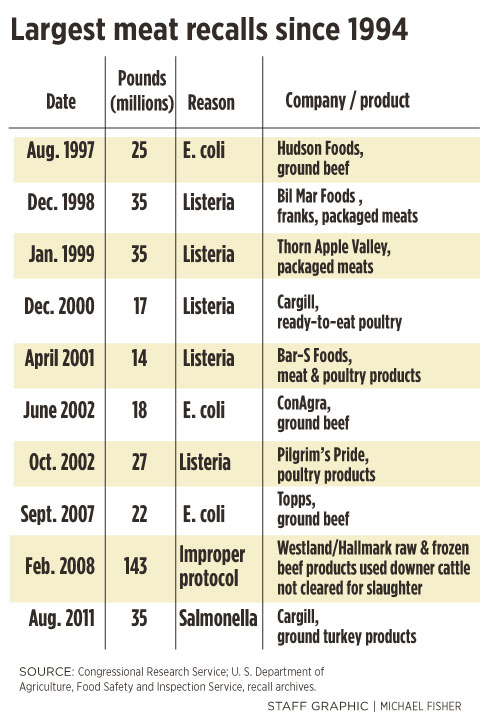
The proposal posted by the agency says it would cost the industry about $20 million to comply, but at the same time would reduce the scale and cost of future recalls, enhance investigations and improve public health.
Hannaford improved its record-keeping practices in February after a salmonella outbreak was traced back to ground beef sold at its stores. The investigation stalled there, however, because federal investigators could not determine from the company’s records which of its suppliers delivered the contaminated meat.
Although the USDA blamed Hannaford’s records for impeding the investigation, the company met all existing federal requirements for record-keeping. The gap in the nation’s food-safety system was highlighted by the Portland Press Herald/Maine Sunday Telegram in a special report published in March.
Hannaford officials said at the time that the company would support regulations requiring better record-keeping at stores that grind beef.
Soon after the recall, the USDA said the agency had been working on a beef grinding rule and that it planned to send a detailed proposal to the Office of Management and Budget last summer.
In the latest version of the proposal, the USDA estimates that the record-keeping requirements would affect more than 76,000 stores and cost them $20.5 million in labor to develop, record and maintain so-called grinding logs.
The agency also anticipates the rule would result in more efficient recalls, an estimated $3.6 million savings, and projects a 30-percent reduction in foodborne E. coli illness, a $23.4 million savings.
The agency also notes the rule could increase consumer confidence and reduce the amount of meat recalled, though it did not project the monetary value of those benefits.
The public comment period on the rule, which typically lasts two months, gives industry advocates and the general public a chance to weigh in on whether the rule is too burdensome or too lax.
If the Office of Management and Budget does not find substantive objections were raised during the comments, a draft final rule would be developed and the review and comment process would be repeated within the USDA and OMB.
If the rule is adopted, retailers would likely get time to comply with it.
Send questions/comments to the editors.

Success. Please wait for the page to reload. If the page does not reload within 5 seconds, please refresh the page.
Enter your email and password to access comments.
Hi, to comment on stories you must . This profile is in addition to your subscription and website login.
Already have a commenting profile? .
Invalid username/password.
Please check your email to confirm and complete your registration.
Only subscribers are eligible to post comments. Please subscribe or login first for digital access. Here’s why.
Use the form below to reset your password. When you've submitted your account email, we will send an email with a reset code.