



Local and state officials don’t expect Maine to be hit as severely by Hurricane Sandy as other Eastern states, but still expect flooding and power outages caused by strong wind.
Gov. Paul LePage on Monday declared a state of emergency as the hurricane approached, allowing state agencies to use available resources and personnel as necessary.
Additional Photos

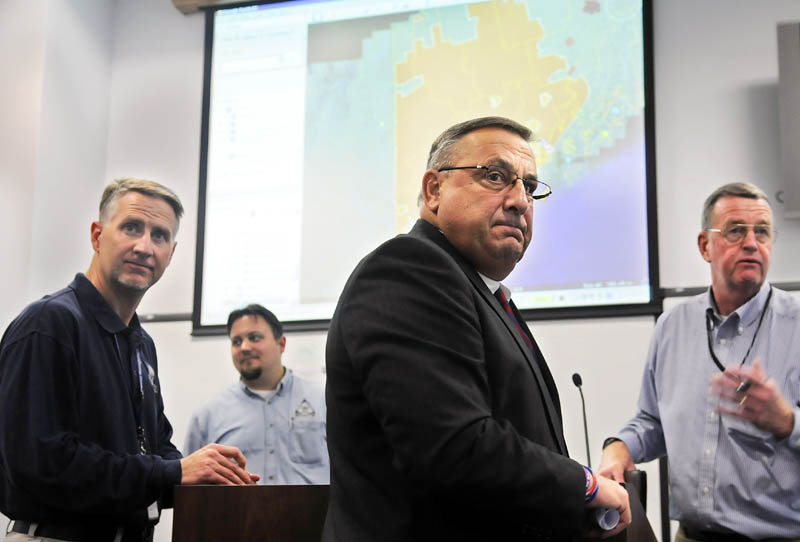
Before the declaration, LePage and Maine Emergency Management Agency Director Robert McAleer reported no significant changes to the storm during a press conference Monday afternoon and said the emergency response team will continue monitoring the storm.
“Obviously this is a very large storm that is going to impact a significant portion of the eastern coast of the country,” McAleer said. Officials expected the greatest impact to be felt in the southern part of the state.
Meteorologist Margaret Curtis, at the National Weather Service’s Gray office, said 1 to 3 inches of rain could fall by the time the storm turns to showers later today and wind gusts could reach 60 mph. Minor local flooding could occur in small streams and brooks, and light rain could continue into Thursday, she said.
“In central Maine, we’re really just looking at a very windy, rainy day with some power outages, maybe a bit worse than your typical October rain storm, but nothing like they are seeing in New Jersey,” she said. “We’re in the warm air and not expecting any snow.”
Curtis said she didn’t expect the Kennebec River to reach flood stage. The biggest issue facing the state as day breaks today will be the effects of high wind, she said.
Even as state officials said they were in contact with the Federal Emergency Management Agency, LePage declined support from its Incident Management Assistance Team — a group of senior-level professionals who provide expertise in operations, logistics, planning and recovery as part of FEMA’s first responders. LePage spokeswoman Adrienne Bennett said that support was declined because other states don’t have a fully operational emergency operation center and will need the support more than Maine, though she couldn’t identify which states.
Jeremy Damren, spokesman for the Maine Emergency Management Agency on Monday, said that all New England states have emergency operation centers. In Maine, the center has members of state agencies that offer resources for state, county and local level as requested in emergencies, and they usually work with county emergency directors, Damren said.
McAleer said the state emergency agency has been in contact with FEMA and will ask for assistance if the need rises, but he didn’t anticipate that happening.
Wind warnings and flood watches were posted by the National Weather Service for Kennebec County through 8 a.m. today.
Central Maine Power Co. called in extra crews from New Brunswick, company spokesman John Carroll said.
CMP reported 26,000 outages as of 5 p.m. Monday, the vast majority in York County.
Carroll said the company’s first priority will be to repair damaged equipment so roads can be cleared in the event of downed trees and power lines. Electrical service restoration will come later, he said.
“We’re ready — everybody in our company is mobilized. We started the day with a safety briefing,”
Carroll said Monday afternoon as Maine residents watched the storm intensify to the south. “We’re brought in almost double the number of crews were would normally have. Normally we have 90 to 95 crews; we brought in another 90 crews.”
Carroll said the company is warning its customers to make preparations for the possibility of multiday outages as strong wind is expected along the coast and toward the mountains and foothills above 1,500 feet.
If outages occur, the company urges customers to call its toll-free outage hotline: 800-696-1000.
In the Monday afternoon press conference, LePage emphasized the importance of avoiding driving if possible, not touching downed power lines and not operating generators inside buildings.
“Basically it’s use a lot of common sense,” LePage said. “Stay out of the elements. Let the storm take its course and be safe.”
Kennebec County Emergency Management Director Richard Beausoleil said people shouldn’t run generators in their garage or basement or within 10 feet of house because of exhaust from the generators.
“We’ve had a weeks worth of warning for this,” he said. “Hopefully people took it seriously.”
Flood watch
Hallowell Police Chief Eric Nason said the city is preparing for localized flooding and power outages.
He said departments have been preparing by fueling vehicles and ensuring equipment that may be needed is in working order.
Nason said he’s most concerned about flooding in the streets caused by clogged storm drains. “A lot of Hallowell is on a hill and everything runs down,” he said.
Nason said the added debris of leaves and branches make flooding more likely, especially during the fall. The corners where Temple and Central streets meet Water Street tend to flood easily, Nason said, and “we’re going to keep a close eye on those.”
City workers, including public works, will be on call and ready in case of flooding or other emergencies, Nason said.
Gardiner has similar concerns of localized flooding caused by clogged drains, said Gardiner Public Works Director Chuck Applebee.
He said that even after clearing the drains at the end of the day today “it won’t take much heavy drain to take more leaves and clog them again.”
Applebee said city workers have been preparing sandbags for flooding as well, and have removed flags and trash cans because of expected strong winds.
Gardiner City Manager Scott Morelli said city workers have been checking generators with expected power outages from the wind.
“We’re preparing for it — preparing for the worst, hoping for the best,” he said.
Beausoleil said there is a flash flood watch for small rivers and streams for Kennebec County.
Cancellations considered
Many organizations canceled events and classes Monday evening and into Tuesday because of the storm.
Secretary of State Charlie Summers canceled the student mock election Rally and Tally event scheduled for today in Augusta, and the University of Maine at Augusta canceled Monday classes after 4 p.m.
Sheri Stevens, executive director of administrative services at UMA, said they have to be particularly sensitive to driving conditions because its an entirely commuting school.
“It’s not necessarily so bad at 4 but these students are in class until 6:45 p.m.,” she said.
Stevens said that they could delay or cancel Tuesday classes, depending on severity of the storm. She said UMA has many parents as students, so they need to be aware that parents may have to arrange for childcare if local schools delay.
Kents Hill School doesn’t anticipate having any delay in classes after the storm, according to spokesman Jason Hersom, unless they lose power for more than a couple days. He said as a boarding school, they have all the necessary resources to continue teaching classes, even without power.
“We’re going to conduct business as usual,” Hersom said.
Hersom said that although they first planned on encouraging day students to stay overnight Monday, they later decided it would be best if they went home as usual.
“In this case, where we’re anticipating a power outage, we would prefer our day students to be home with their parents,” he said.
Classes were canceled today in Vassalboro, Waterville and Winslow by district officials in Alternative Organizational Structure 92. Officials in other school districts said they will wait to see what conditions prevail before making a decision on closing school for the day.
Staff writer Doug Harlow contributed to this report.
Paul Koenig — 621-5663
pkoenig@mainetoday.com
Send questions/comments to the editors.

Success. Please wait for the page to reload. If the page does not reload within 5 seconds, please refresh the page.
Enter your email and password to access comments.
Hi, to comment on stories you must . This profile is in addition to your subscription and website login.
Already have a commenting profile? .
Invalid username/password.
Please check your email to confirm and complete your registration.
Only subscribers are eligible to post comments. Please subscribe or login first for digital access. Here’s why.
Use the form below to reset your password. When you've submitted your account email, we will send an email with a reset code.